

Yellow-legged Hornet
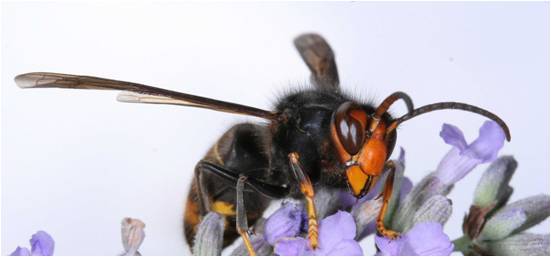
Formerly called the Asian hornet, the Yellow-legged hornet was introduced to France in 2004 where it has spread rapidly. A number of sightings have been recorded in the UK since 2016 including Devon, with the Tamar Valley National Landscape located in an area vulnerable to increased Yellow-legged hornet activity.
There is a rapid increase in numbers in other counties along the south coast last year and a number of the insects being inadvertently brought to the UK from mainland France.
A highly aggressive predator of native insects, this species poses a significant threat to honey bees and native pollinators. The Yellow-legged hornet should not be confused with the smaller, native European hornet.
More Information and downloadable ID sheet
Seasonal activity - what to look out for
Below is a month‑by‑month overview of Yellow‑legged (Asian) hornet behaviour in the UK, based on the species’ established life cycle and UK‑specific observations from DEFRA, the National Bee Unit, and beekeeping organisations. This reflects current UK conditions, where the species is not yet fully established but is appearing more frequently.
Monthly Behaviour in the UK
January – February
- Only fertilised queens survive winter, hidden individually in sheltered places (soil, sheds, bark, buildings).
- No nests or worker activity.
- Hornets are inactive and very rarely seen.
March
- In mild springs, queens emerge from hibernation.
- Queens feed on tree sap, nectar, or fallen fruit to regain strength.
- Suitable areas: gardens, parks, woodland edges.
- This is the earliest realistic time sightings occur in southern England.
April
- Queens begin building primary (embryo) nests, often small and hidden:
- Sheds, hedges, roof eaves, garages, bird boxes.
- Egg‑laying starts; queen does all foraging and care.
- Key detection window for monitoring and trapping queens.
May
- First worker hornets emerge.
- Workers take over foraging and nest expansion.
- Queen remains in the nest laying eggs.
- Hunting pressure on insects begins to increase but is still limited.
June
- Colony growth accelerates.
- Secondary nests may begin forming, often higher in trees.
- Workers become more visible.
- Predation on bees increases around apiaries.
July
- Nests grow rapidly and may reach football size or larger.
- Intensive hawking behaviour outside beehives (hovering and catching bees).
- Worker numbers rise into the hundreds or thousands.
- Public sightings become more common.
August
- Peak activity month.
- Very high impact on honey bees and other insects.
- Large secondary nests often high in trees or buildings.
- Hornets are active all day but not at night.
- Most UK nest discoveries happen from August onwards.
September
- Colonies produce new queens and males.
- Feeding demand is highest.
- Aggression near nests increases (defensive behaviour).
- Critical time for nest finding and destruction to prevent overwintering queens.
October
- Mating occurs.
- Fertilised queens leave the nest to seek overwintering sites.
- Worker numbers start to decline.
- Old nests begin to fail.
November
- Remaining workers and males die off naturally.
- Old nests become inactive and are not reused.
- Only hibernating queens remain alive.
December
- Complete dormancy.
- No visible hornet activity.
- Risk resumes the following spring if queens survive.
Key UK Notes
- Asian hornets are not yet established in the UK, but overwintering has now been confirmed in southern England.
- Early spring queen control (March–May) is the most effective prevention strategy.
- Any sighting should be reported using the Asian Hornet Watch app
Recognising Yellow-legged (Asian) hornets and their nests
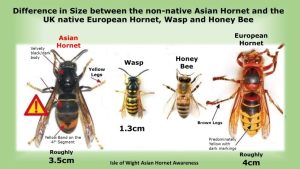
Photo: Isle of Wight Beekeepers Association website
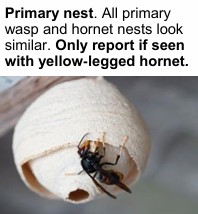
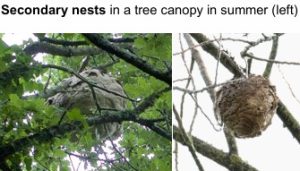
Nest photos: GB Non-native Species Secretariat website

The British Beekeepers’ Association (BBKA) leads an annual Asian Hornet Week at the beginning of September, to raise awareness raising held when the insects are at their peak in terms of activity and are most likely to be seen.
This highly predatory hornet could decimate our pollinators, so it is important to have everyone actively looking for it.

Do not disturb an active nest.
Members of the public who suspect they have found an Asian Hornet should report it with a photo using;
- the iPhone and Android recording app: Asian Hornet Watch
- online at: www.nonnativespecies.org/alerts/asianhornet
- by email: alertnonnative@ceh.ac.uk
Get involved!
The UK Government is currently in the eradication phase of management of the Asian hornet incursion, meaning that any suspected sightings should be reported to the National Bee Unit, who will then track, trace and destroy any nearby nests.
The Great British Invasive Non-Native Species Secretariat provide updates on sightings.
For more information on identification and reporting , please visit the:
Asian Hornet alert page